The Science and Uniqueness of BioFixation
Everything you feel, perceive, remember, desire, fear, your self-awareness, your beliefs, essentially your mind, is the product of electrochemical processes enabled by the neural structures that are unique to your brain.
The key intuition behind BioFixation is that if the structural integrity of someone’s brain is preserved at the resolution of individual proteins, this suffices to capture the brain’s structure and electrochemical functions, hence the mind of the individual.
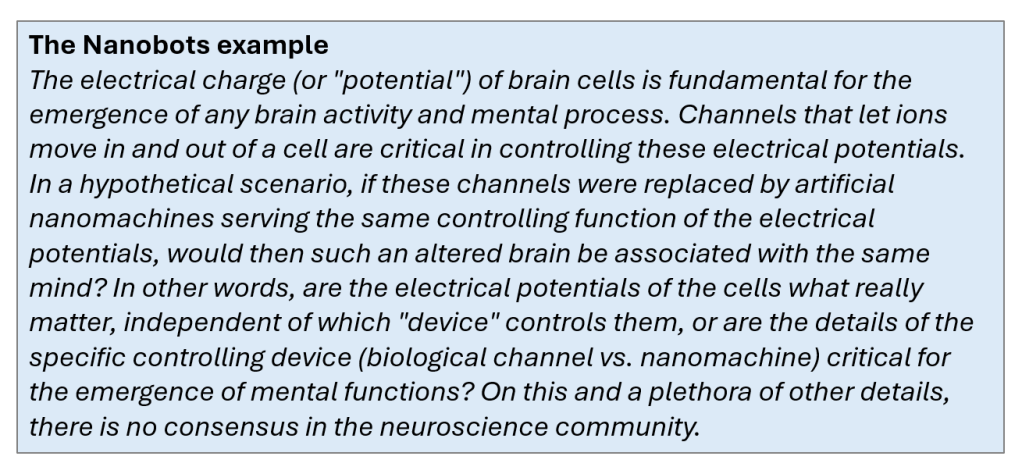
The understanding that the mind is the product of electrochemical brain processes (and the biological structures that allow these processes to exist) has gained unanimous consensus in the neuroscience community. What remains debated is the level of “details” that are relevant.
However, most neuroscientists (there are always outliers) would agree that if a very advanced technology were available to build a brain from scratch, we would not need a replica of the original matched atom-by-atom. Rather, the spatial resolution of proteins would likely suffice. Proteins are the building blocks of many interesting cellular machineries and structures in the brain, shaping the elements that imbue cells with a function. The protein-level resolution is where structure (of the proteins and the various small constituents that make up cells) meets cellular function, together with cell-to-cell communication within large networks, and essentially of the whole brain.
Hence, it is reasonable to assume that if the structural integrity of someone’s brain is preserved at the resolution of individual proteins, this suffices to capture the brain’s structural and electrochemical properties that define a person’s mind.
If brain preservation is implemented right after the point of death, when biodegradation is still minimally disruptive, the mind would effectively be put in a state of biostasis, where all information that makes up the mind is preserved and put on “pause,” following the chemical blockage of all functional processes.
Notably, an effective methodology to achieve this is currently available: the first ingredient is a chemical process called cross-linking, where a perfused chemical agent provides something similar to a scaffolding to keep the structure of proteins and other small molecules in place. However, over the weeks and months, residual enzymatic and thermal effects can break down the cross-linking, hence a second step is necessary to ensure long-term structural integrity. In resin embedding methods, a resin permeates through every “nook and cranny” in the neural tissue, acting like cement to keep biological structures in place. For an analogy, this is akin to what is observed when an insect is embedded in jade, with a preservation of relatively fine structural elements lasting possibly for millions of years.
This technology is currently available and developing at a fast pace, but it has been applied to small neural structures. Hence, at BioFixation we will engage in significant R&D to optimize both chemical fixation and resin-embedding methods for human-sized brains.
Uniqueness
The ideas upon which BioFixation is built are supported by an overwhelming amount of scientific research; thus, it is not too surprising that these ideas have already attracted millions of dollars in a similar field, that of Cryonics. Although Cryonic organizations (Cryonics for brevity) and BioFixation share the same core goal—to prolong human life beyond the point of natural death—we depart on procedural, scientific, and conceptual aspects.
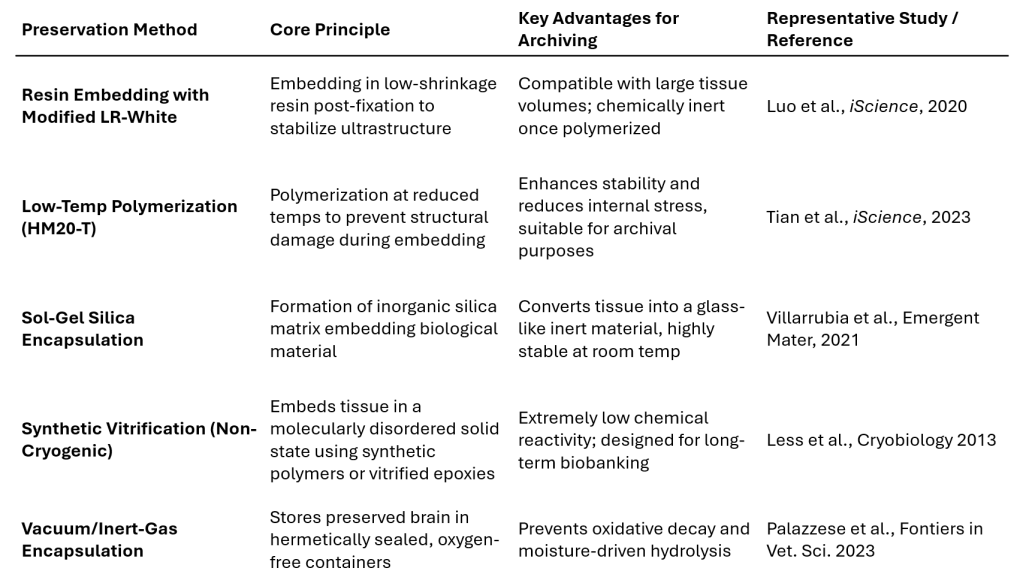
BioFixation aims to use room-temperature bioarchiving methods (see table below) instead of cooling of the brain or the whole body as done in Cryonics. Cooling is a solution we do not favor, relying on regular supplies of the cooling agent and maintenance of storage facilities and infrastructures. Furthermore, storing brains in warehouses or traditional buildings assumes a fair degree of long-term sociopolitical stability, over several centuries, possibly millennia. This assumption is in our view unrealistic and exceedingly risky.
Our approach is unique also conceptually: to bring someone’s mind out of biostasis, brain preservation should be followed by (1) information retrieval from the preserved brain, (2) deciphering of such information, that is, making sense of it, computationally, and (3) using such information to reconstitute the mind in a biological (e.g., a cloned brain) or a synthetic substrate (e.g., a neuromorphic brain)—see our “light-hearted” video describing these steps. In Cryonics, steps 1-3 can possibly be sacrificed, treating the brain like a transplantable organ, for example, a liver or a kidney. To transplant a kidney brought back to room temperature after a cryopreservation process, a surgeon doesn’t necessarily need to know the biophysics of glomerular filtration (better if s/he does, of course!). Similarly, Cryonics considers cryopreserved (“vitrified”) brains as organs to be brought back to room temperature (possibly together with the whole body), relying on future medicine to cure whatever underlying disease killed the person (including aging). Alternatively, Cryonics proposes “mind uploading,” for instance into a computer, something that, if possible at all, we would argue necessitates steps 1-3, as listed above. Furthermore, the timeframe hypothesized by Cryonics for all of this to happen is a few decades, a couple of centuries at the most, which is at least one order of magnitude shorter than what we estimate.
Our strategy relies heavily on AI and ML to guide the design of preservation protocols. By modelling molecule-to-molecule interactions and diffusion processes on accelerated time scales, these tools will guide the development of individual methodologies and their combination.
Risk-Management
The uniqueness of BioFixation in the context of risk management is particularly clear when considering an implicit assumption often common among organizations in the field of life-extension and body-preservation technologies. This assumption states that if an approach offers a chance of avoiding certain death, it is worth pursuing and funding, no matter how slim the odds are (an argument that could also apply to religious beliefs too). Instead, at BioFixation we believe that pristine brain preservation together with safe and reliable long-term storage of the brain, safeguarded from sociopolitical fluctuations, are absolutely critical. Anything less than this can be considered as offering a false hope.
All together, the distinctive conceptual pillars upon which BioFixation is grounded can be summarized in three points: (1) it’s critical to gain a scientific understanding of the structural and electrochemical brain processes giving rise to the mind, (2) it will take science and technology centuries, possibly millennia, to gain this understanding and figure out how to then reconstitute the mind, and (3) we should not have much trust in our currently infantile societies, foreseeing self-inflicted slowdowns in scientific progress and significant sociopolitical instabilities in the years to come. We might be wrong, with the next decades characterized by hyper-exponential progress in neuroscience and neurotechnologies, associated with continued socio-political stability, but from a risk-management perspective, better be safe than sorry. The ‘commodity’ at stake is quite precious: our own mind!
 BioFixation